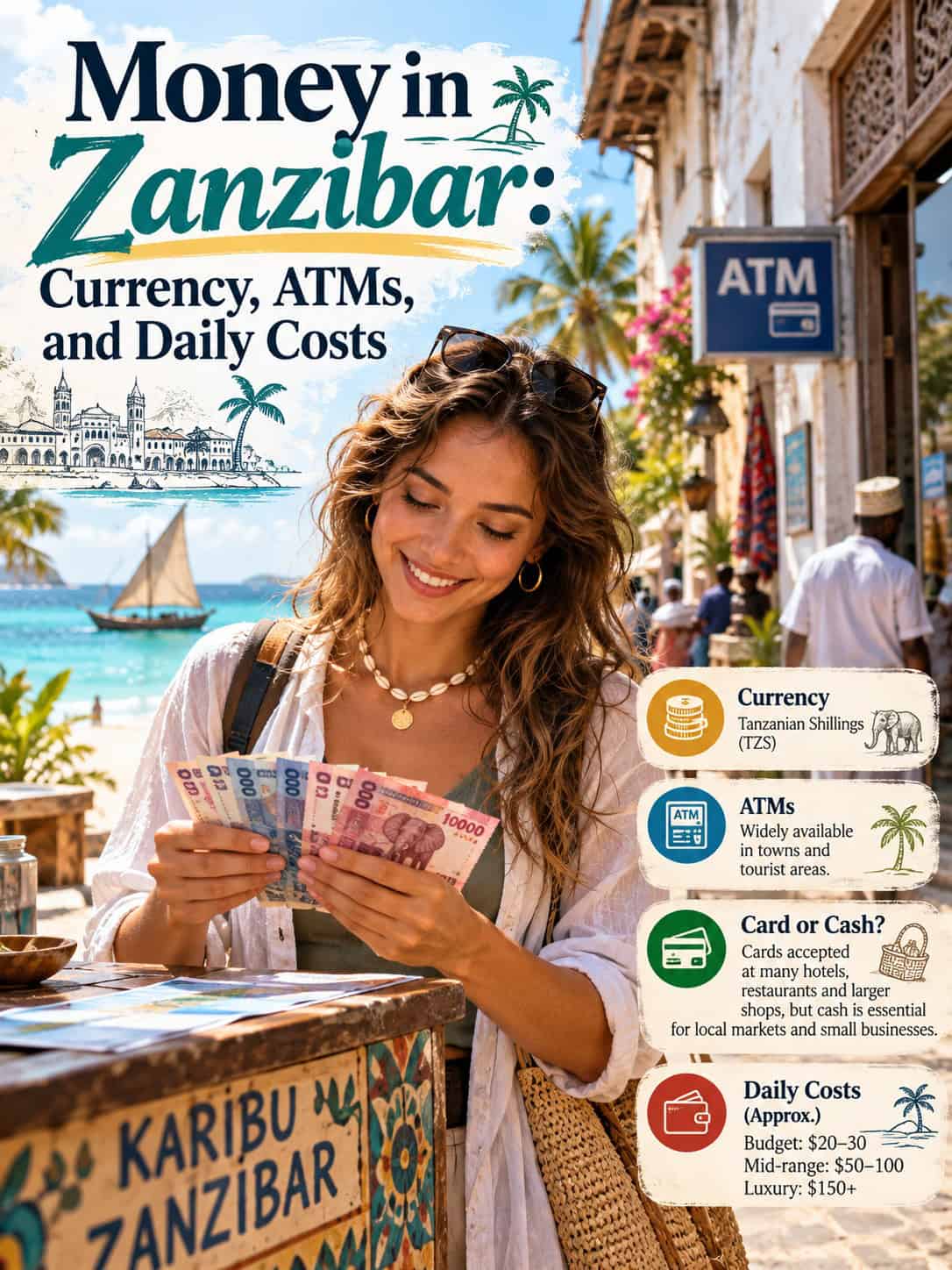
Quick answer: The currency is the Tanzanian shilling (TZS), about 2,640 TZS to the US dollar in late October 2026. Carry shillings for everyday spending and do not assume that hotels or tours require US dollars; check each provider’s payment terms before you arrive.
Zanzibar currency is the Tanzanian shilling (TZS). Check the Bank of Tanzania exchange rate, withdraw local cash safely and compare payment methods before spending money on the island.
The Tanzanian shilling is the legal tender in Zanzibar and mainland Tanzania. The 2025 foreign-currency regulations generally require local prices and payments in TZS, while the Bank of Tanzania clarified exceptions for some tourist transactions involving non-residents. Do not assume that all hotels, tours or park fees require US dollars. Carry TZS for everyday spending, and check a provider’s payment terms before arrival. Worth checking the SIM card guide before you go.
Zanzibar Currency: Tanzanian Shillings and Exchange Rates
The Tanzanian shilling (TZS) serves as the official currency in Zanzibar and mainland Tanzania. On 27 October 2026, the Bank of Tanzania published a USD/TZS mean rate of 2,637.6573, with buying at 2,624.5347 and selling at 2,650.7800. These are dated reference rates, not a promise of the same rate at every ATM or bureau. Current banknote issues include TZS 1,000, 2,000, 5,000 and 10,000; older 1985–2003 series notes and the 2010 TZS 500 note stopped being legal tender after April 5, 2025, so do not accept them in change. Always check the official daily rate before exchanging.
Zanzibar Exchange Rate: USD to TZS Example
The Bank of Tanzania’s mean rate on 27 October 2026 was 1 USD = 2,637.6573 TZS. The following conversions use this reference only; they do not include bank spreads or fees.
| US dollars | Approximate TZS on 27 Oct 2026 |
|---|---|
| US$1 | 2,638 |
| US$5 | 13,188 |
| US$10 | 26,377 |
| US$20 | 52,753 |
| US$50 | 131,883 |
| US$100 | 263,766 |
Find today’s reference rate on the Bank of Tanzania exchange-rate page. Compare the actual cash selling/buying rate or the final card conversion before paying.
Can Tourists Pay in US Dollars in Zanzibar?
Tanzania introduced foreign-currency regulations on 28 March 2025. Its central bank stressed that shillings remain legal tender and businesses must accept them. In June 2025, the bank clarified that some transactions between residents and non-residents, including tourism services, may use foreign currency. In practice, US dollars are still widely accepted in tourist areas, mostly by hotels and tour operators, while markets, dala-dalas and small shops work in shillings. Carry TZS for daily spending and confirm how the specific hotel or tour operator will bill you. Entry rules are covered in the Zanzibar visa guide.
Zanzibar Money: Cash, USD and Exchange Bureaus
If you bring US dollars to exchange into the Zanzibar currency, choose clean, undamaged notes. Individual banks and exchange bureaus decide which notes they accept; there is no island-wide rule that only bills issued after 2009 are accepted, but banks and bureaus may refuse worn, torn or heavily marked notes. Ask your accommodation whether you need cash at all before changing a large amount.
Use an authorised bank or licensed bureau de change to exchange cash into the Zanzibar currency. Compare the displayed buying and selling rates and request a receipt. An airport counter may offer a different rate from a Stone Town bureau, but compare quotes instead of assuming which will be better. Do not rely on ordinary shops to exchange currency.
Exchange only the cash you expect to use and keep receipts. Do not assume a fixed 10% loss when changing money back; the result depends on the two exchange rates and fees. Declare large amounts of cash to customs when you arrive or leave. Worth reading alongside airport transfer options before you book transport.
Zanzibar ATM Guide: Locations, Fees and Withdrawal Limits
ATMs operate in Stone Town, around Zanzibar Airport and in some beach villages. Reported examples include Absa and NMB machines in Paje and an Absa machine near Nungwi’s main road. Barclays Tanzania became Absa, so older Barclays references are outdated. Check the current bank locator and carry backup cash for remote areas.
ATMs set different per-transaction and daily limits. Many machines cap a single withdrawal at around TZS 400,000, some allow more, and your home bank may impose a separate daily limit. The tourism ministry’s 2025 guidebook gives a maximum of TZS 1,000,000 per transaction as a general planning reference and warns that withdrawal fees may reach US$7. Check the screen and your card issuer’s tariff before accepting a withdrawal.
Zanzibar ATM Locations: Where to Look
| Area | Reported banks / locations | Before you travel |
|---|---|---|
| Stone Town | CRDB, NMB, NBC and other central branches | Use a bank locator |
| Zanzibar Airport | Bank machines around the airport area | Confirm terminal location and hours |
| Paje | Absa near UP petrol station; NMB near Petro; Exim at roundabout | Check live operation and cash availability |
| Nungwi | Absa near the main road / UP petrol station | Do not rely on old Barclays listings |
| Remote beach villages | Limited or uncertain coverage | Withdraw before leaving a larger town |
Banks may relocate machines, and ATMs sometimes break down or run out of cash, so withdraw what you need in a larger town before heading to a quiet beach. Machines inside or attached to a bank branch carry less risk of card cloning than standalone ones. Shield your PIN and decline unsolicited help.
Zanzibar ATM Fees: Understand the Total Cost
The total withdrawal cost may include a local operator fee, your home bank’s charge and a currency-conversion spread. Some ATMs offer to charge your card in its home currency; compare that displayed rate with your bank’s expected TZS conversion before accepting. Under Visa rules, the screen has to show the exchange rate and any extra markup, and the machine should let you decline the conversion and be charged in shillings.
Worked example: If you withdraw TZS 200,000 and the ATM displays an additional TZS 15,000 fee, the fee alone equals 7.5% of the cash withdrawn. Fewer, larger withdrawals keep this fixed cost down.
Zanzibar Money: Paying by Card and Avoiding Extra Fees
Paying with the Zanzibar currency is not the only option: many larger hotels and tourist restaurants accept international cards, but smaller businesses may prefer TZS cash. A 3.5% card surcharge is not a standard island-wide charge: some merchants add a fee and others do not. Ask whether a merchant adds a fee and check your bank’s foreign-transaction charges. Pay in TZS when the terminal offers currency conversion unless your own rate comparison shows otherwise. Enable card alerts and confirm overseas usage with your bank.
There is no universal cash-to-card ratio. Hold enough shillings for taxis, markets, meals and small expenses. Use cards where the merchant accepts them and the total fees make sense. Keep a separate emergency payment method.
How Expensive Is Zanzibar? Travel Prices and Daily Budget
Zanzibar prices, quoted in the local currency, vary by hotel category, season and excursion choices. A single US$150–300 daily figure does not describe a budget guesthouse and a premium beach resort equally well. Calculate your own total from accommodation, meals, transport, attractions, insurance and card or ATM charges. Use current quotes for your exact dates rather than a fixed island-wide average. If you are ready to book, our breakdown of Jambiani’s budget guesthouses covers real prices and ratings.
Zanzibar Prices: Build a Realistic Daily Budget
| Expense | What to enter | Check before paying |
|---|---|---|
| Accommodation | Actual nightly quote divided by guests | Local taxes, breakfast, cancellation |
| Meals | Breakfast, lunch, dinner, drinks | Hotel plan and any service charges |
| Transport | Airport transfers and local taxis | Price per vehicle, return journey |
| Activities | Chosen tour prices divided by trip days | Marine fees, entrance charges, gear |
| Payments | ATM fees and card conversion charges | Actual machine and issuer tariffs |
| Insurance | Mandatory inbound policy when applicable | Eligibility, price and coverage |
Use your own hotel and tour quotes to estimate how expensive Zanzibar will be for your specific trip. A cheap guesthouse and a premium all-inclusive resort create very different totals. For local transport costs, see getting around Zanzibar.
If Zanzibar is your first point of entry into Tanzania, the mandatory inbound travel insurance from the Zanzibar Insurance Corporation costs US$44 per adult and US$22 per child and is valid for up to 92 days.
Zanzibar Money: Tipping Without Fixed Dollar Rules
Tipping is voluntary, and the Zanzibar currency works best for small amounts. Check restaurant bills for an included service charge before leaving extra money. You may tip a guide, driver or porter for good service, but no island-wide rule sets a mandatory 10% restaurant tip or fixed US-dollar amount per worker. Tanzanian shillings are practical for local tips. If a service provider quotes or accepts another currency under an applicable tourism exception, confirm the arrangement rather than assuming all businesses accept US dollars.
Zanzibar Currency: Bottom Line
Use the Zanzibar currency (Tanzanian shillings) for daily purchases, compare exchange rates and verify card charges. ATMs exist beyond Stone Town, but remote areas still require advance cash planning. Check the 2025 currency rules and applicable tourism exceptions before paying in dollars.
FAQ
What currency is used in Zanzibar: dollars or shillings?
The official currency is the Tanzanian shilling (TZS). Keep shillings for local spending. Some international-tourism transactions may permit foreign currency, but check the provider’s terms and applicable rules.
Do ATMs work in Zanzibar?
Yes. Stone Town, the airport area and some beach villages have ATMs. Cash availability varies, so use a bank locator and carry a backup. Our safety guide covers the practical side of this.
Why do some places refuse my US dollar bills?
Banks and bureaus may reject damaged or heavily marked notes. Choose clean bills; each bank or bureau sets its own rules, and there is no single universal cutoff year such as 2009.
Are credit cards widely accepted in Zanzibar?
Many hotels and tourist restaurants accept cards. Fees depend on the merchant and your bank, not one standard percentage. Carry TZS cash for smaller businesses.
How much should I budget per day in Zanzibar?
Your daily cost depends on your room rate, food, transport and tours. Use current hotel prices and an itemised budget rather than a fixed US$150–300 per day. Our packing list also helps you plan what to bring rather than buy.
What is the Zanzibar exchange rate today?
The rate changes. Check the Bank of Tanzania daily exchange-rate table. Its reference mean was TZS 2,637.6573 per US$1 on 27 October 2026; your ATM or bureau will use its own applicable rate.
Where can I find a Zanzibar ATM near Nungwi or Paje?
Reported machines include Absa in Nungwi and Absa, NMB and Exim in Paje. Check the live bank locator; cash and availability can change.
How expensive is Zanzibar for a week?
Multiply the actual nightly room rate by your stay and add meals, transfers, activities and payment fees. A single average does not reliably describe every travel style.
Should I pay in TZS or let a card terminal convert to USD?
Compare both final exchange rates and charges. Paying in local currency often avoids an expensive merchant conversion, but your card issuer may still apply fees.
Are Zanzibar prices usually quoted in dollars?
Local prices generally use Tanzanian shillings under the 2025 rules. Specific international-tourism transactions may qualify for foreign-currency arrangements. Ask the provider how it will charge you.
Before you travel, an Africa regional eSIM can help you use banking and map apps, and you can book an airport transfer to avoid cash haggling on arrival; verify coverage before purchase.
 By Zanzibar With Me EditorialPublished Updated