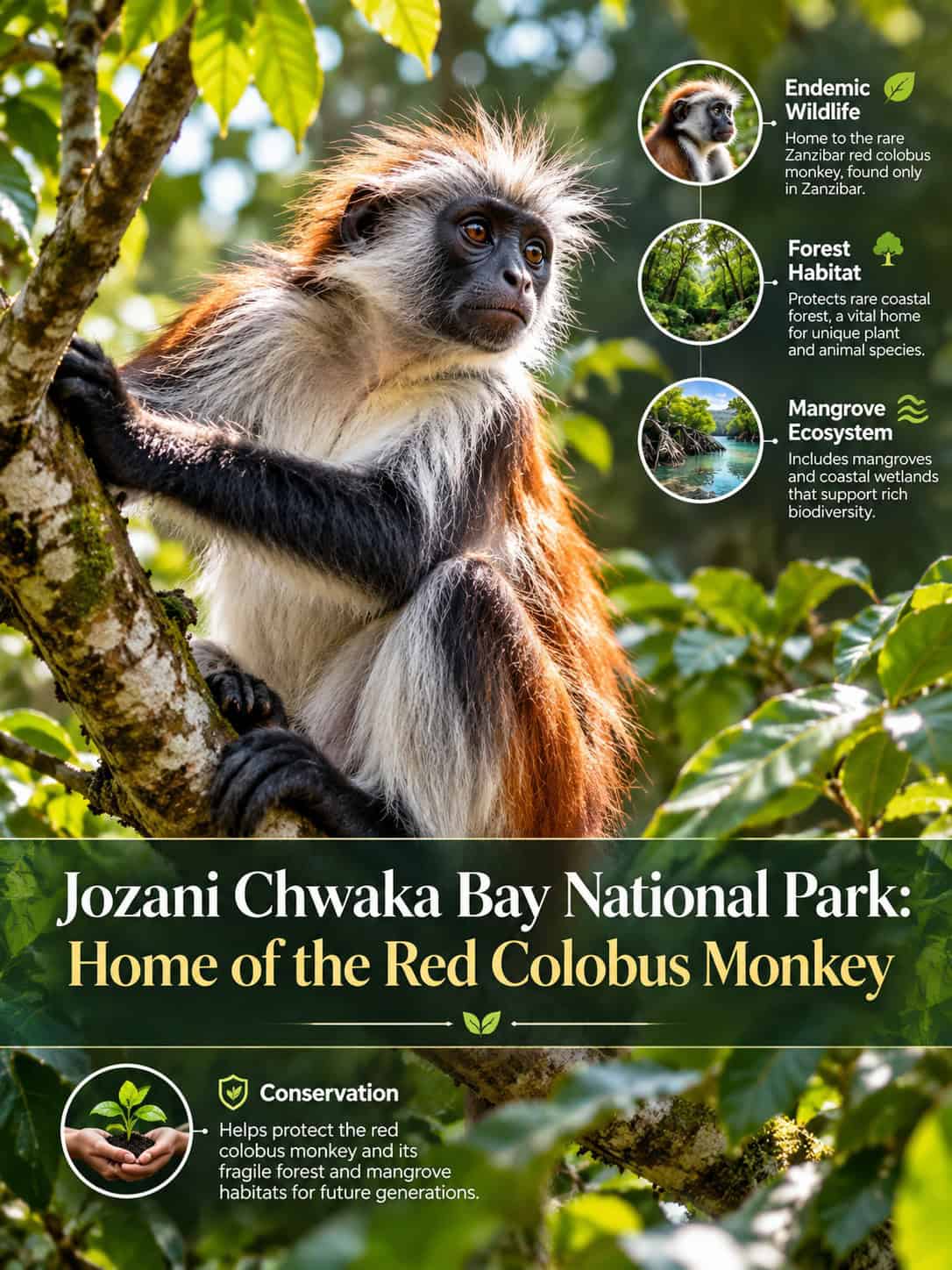
Jozani Forest Zanzibar protects the endangered Zanzibar red colobus. A guided forest trail and a mangrove boardwalk let visitors explore two different habitats.
Jozani is where you can see a primate that lives naturally only on Unguja, in one of the island’s last significant stands of natural forest. For where to actually stay, see Jambiani’s budget guesthouses.
Jozani Chwaka Bay National Park: Location and Habitats
Jozani Chwaka Bay National Park covers roughly 50 km², or 5,000 hectares. UNESCO lists the Jozani–Chwaka Bay Conservation Area on Tanzania’s World Heritage Tentative List, submitted in 1997. A tentative listing does not make this park a UNESCO World Heritage Site.
Jozani lies about 35–38 km from Stone Town by common road routes (see how far each beach is from Stone Town). Allow around 45–60 minutes by private car. Paje and Jambiani are often closer by road. Check the distance from your exact hotel.
The park combines several habitats: indigenous groundwater forest at its core, coastal forest and grassland around the edges, and mangrove and salt-marsh wetland along Chwaka Bay, where a separate boardwalk near Pete village leads into the mangroves.
Jozani Forest Monkeys: Zanzibar Red Colobus Facts
The Zanzibar red colobus (Piliocolobus kirkii) lives naturally only on Unguja. The IUCN lists it as Endangered. A systematic island-wide survey conducted in 2013–2014 and published in Oryx estimated 5,862 monkeys in 342 groups. This is a dated scientific estimate, not a live 2026 population count.
The survey estimated 4,042 monkeys in protected areas (69%) and 1,820 outside them (31%). It also counted approximately 2,907 within Jozani Chwaka Bay National Park, roughly half of the island’s estimated total in a single park. These results refer to the study period.
The same research team found that red colobus had disappeared from four forests where they were previously recorded, while Unguja was losing more than 19 square kilometers of forest a year. That loss is why the protected forest at Jozani matters so much for the species.
Researchers recorded groups of 3–52 monkeys, with an average size of 17.12. Adult females outnumbered adult males by about 3.3 to one. Morning visits can offer active feeding, but no sighting is guaranteed. Guides ask visitors to keep their distance and never to feed or touch the monkeys, even though those near the forest edge are used to people.
Zanzibar Red Colobus Monkeys: Scientific Census
| 2013–2014 survey metric | Result |
|---|---|
| Estimated population on Unguja | 5,862 |
| Recorded groups | 342 |
| Within protected areas | 4,042 (69%) |
| Outside protected areas | 1,820 (31%) |
| In Jozani National Park | About 2,907 |
| Mean group size | 17.12 |
Davenport and colleagues published this island-wide survey in Oryx in 2019. These figures do not represent a 2026 live census.
Sykes’ monkeys, also called blue monkeys, share the forest with the colobus, along with bushbabies that are more often heard than seen. The Zanzibar Butterfly Centre near Pete village is a separate, ticketed conservation attraction.
Zanzibar Leopard: History and Reported Sightings
No living Zanzibar leopard population has been recorded in recent decades. Reports of sightings remain disputed. Many Zanzibaris believe leopards survive, a belief tied in local tradition to witchcraft and “kept” leopards, which is worth knowing before a guide raises it. Treat any claim of extinction or a precise taxonomy with caution.
Jozani Forest Tour: Pete Mangrove Boardwalk
Near Pete village, a raised boardwalk passes mangroves and tidal flats by Chwaka Bay. Many guided itineraries allow around 20–30 minutes. Ask which sections the park currently opens and whether the mangrove walk comes with your ticket. The mangroves are a nursery habitat for fish and crabs and a buffer against coastal erosion, so take a few minutes to stop and look.
Jozani Forest Entrance Fee, Guides and Opening Hours
Park visitors follow a guided forest route. Independent 2026 sources commonly quote US$10–12 per foreign adult including a park guide, while some reports cite higher amounts. No current official Zanzibar government price list was confirmed. Ask the park reception for the exact ticket, child discounts and inclusion of the Pete boardwalk. Tour transport normally costs extra.
Published hours conflict. Some independent guides report 7:30 AM–5:00 PM. A private Jozani tour operator lists 8:00 AM–4:00 PM, with last entry at 3:00 PM. Confirm the schedule with the park or your operator. Allow approximately 90–120 minutes for both the forest and mangrove sections, excluding transport.
Jozani Forest Entrance Fee: Park Ticket vs Tour
| Expense | Planning evidence | What to verify |
|---|---|---|
| Adult entry | About US$10–12 in several independent 2026 reports | Official amount at reception |
| Ranger guide | Generally included with the entry ticket | Whether the Pete boardwalk is also included |
| Children | Discounts commonly reported | Age thresholds and identification |
| Opening hours | Reports disagree: 7:30–17:00 or 8:00–16:00 | Last entry for your visit date |
| Independent tour transport | Separate unless a tour package includes it | Pickup, return trip and total cost |
Jozani belongs to Zanzibar’s conservation system, not mainland TANAPA. Do not use TANAPA or Tanzania Forest Services tariffs as a substitute for the park’s actual ticket.
How to Get to Jozani Forest Zanzibar
From Stone Town, budget roughly 35–38 km and 45–60 minutes by road. Many hotels around Paje or Jambiani lie about 20–45 minutes away, depending on the route. Taxis and organised transfers simplify the trip. Local buses may pass the road near Jozani, but ask locally about stops and schedules.
Jozani Forest Tour: Transport and Time
| Starting point | Planning estimate | Tip |
|---|---|---|
| Stone Town | 45–60 minutes | Allow roughly 35–38 km |
| Paje | 20–35 minutes | Practical half-day visit |
| Jambiani | 25–45 minutes | Depends on hotel position |
| Nungwi / Kendwa | 90–120 minutes | Consider a longer day trip |
Driving times are estimates, not a guarantee. Confirm the hotel pickup and whether the ticket and guide come with the excursion. Many visitors combine Jozani with Kizimkazi or the old town of Stone Town.
Jozani Chwaka Bay National Park: Three Visitor Experiences
| Experience | What to see | Practical detail |
|---|---|---|
| Guided forest walk | Red colobus, Sykes’ monkeys and woodland birds | Follow the guide; never feed or touch primates |
| Pete mangrove boardwalk | Mangrove roots, mud crabs and tidal habitat | Check inclusion in the tour |
| Zanzibar Butterfly Centre | Separate conservation attraction | Ask for its own ticket price |
Jozani Forest Zanzibar: Families and Short Visits
Jozani suits anyone making the drive between Stone Town and the east coast, wildlife-curious travellers who want a wild primate encounter and families: the walk is flat and manageable. It works best folded into a transfer day or paired with the Butterfly Centre and a coastal stop.
Best Time for a Jozani Forest Tour
June to October is generally drier. March to May usually brings the heavier rains, while shorter rains can occur from October to December. Slippery paths can follow any shower. You can visit Jozani throughout the year; monkey sightings vary.
Jozani Forest Zanzibar: Half-Day Itinerary
Morning: Meet the park guide and walk the forest trail. Continue to Pete if your visit includes the mangrove boardwalk. Allow 90–120 minutes inside the park. Afterwards, add the Butterfly Centre or return to Paje, Jambiani or Stone Town. Check the day’s confirmed opening and transfer arrangements.
Jozani Forest Zanzibar: Visitor Checklist
A guide is usually included: You follow a guided route, so budget for a guide even if the entry ticket covers it.
Population figures: The peer-reviewed island-wide census estimated 5,862 Zanzibar red colobus in 342 groups. Treat the result as a benchmark from the 2013–2014 survey, not a current headcount.
Dress for a forest, not a beach: Closed, non-slip shoes and some leg coverage make the walk more comfortable, and bring insect repellent and water; food options inside the park are limited.
Costs: Independent 2026 sources commonly report roughly US$10–12 per adult, including a park guide. Confirm the current park tariff and whether the Pete boardwalk comes with it. Allow around 90–120 minutes for a typical visit, excluding travel.
A guided option is the Zanzibar Nature Tour: Jozani Forest, Red Colobus, Rock Restaurant. Our The Rock restaurant guide covers the restaurant stop on that route.
Jozani Forest Zanzibar: Bottom Line
Visit for Zanzibar red colobus monkeys and Chwaka Bay’s mangroves. Confirm the park fee, opening hours and route. Stay on marked paths and give wild primates space.
FAQ
Can I see the red colobus monkey anywhere else in the world?
It lives naturally only on Unguja, Zanzibar’s main island. A small introduced population lives on Pemba from a 1970s relocation, but that is not part of its natural range.
Is the Zanzibar leopard actually extinct?
No living population has been recorded in recent decades, and reported sightings remain disputed.
Do I need a guide to visit Jozani Forest?
Park visitors follow a guided forest route, and the guide is generally included with the ticket. Confirm how the Pete mangrove boardwalk is covered.
How much does it cost to visit, and how long should I plan for?
Independent 2026 sources commonly report roughly US$10–12 per adult, including a park guide. Confirm the current price locally. Allow around 90–120 minutes for a typical visit, excluding travel.
Can I combine Jozani with other Zanzibar attractions in one day?
Yes. It sits on the main route between Stone Town and the east-coast villages, and the Zanzibar Butterfly Centre is nearby at Pete, making it an easy stop rather than a special trip of its own.
What is the Jozani Forest entrance fee?
Independent reports commonly cite US$10–12 per foreign adult including the park guide. Ask reception to confirm the official amount and child policy.
What are the Jozani Forest opening hours?
Some guides list 7:30 AM–5:00 PM, while a tour operator reports 8:00 AM–4:00 PM. Confirm your visiting day and last entry directly.
Can I see Zanzibar red colobus monkeys elsewhere?
Yes. Wild populations also inhabit other parts of Unguja. Jozani provides one of the most accessible guided viewing opportunities.
Does a Jozani forest tour include mangroves?
Some tours include the Pete boardwalk, while others offer only the forest trail. Check the written itinerary before payment.
How long is the Jozani Forest tour?
Allow roughly 90–120 minutes for the forest and mangrove sections. Add travel time and any separate stops.
Is Jozani Forest a UNESCO World Heritage Site?
No. UNESCO lists Jozani–Chwaka Bay on Tanzania’s World Heritage Tentative List. A tentative listing is not a World Heritage inscription.
 By Zanzibar With Me EditorialPublished Updated