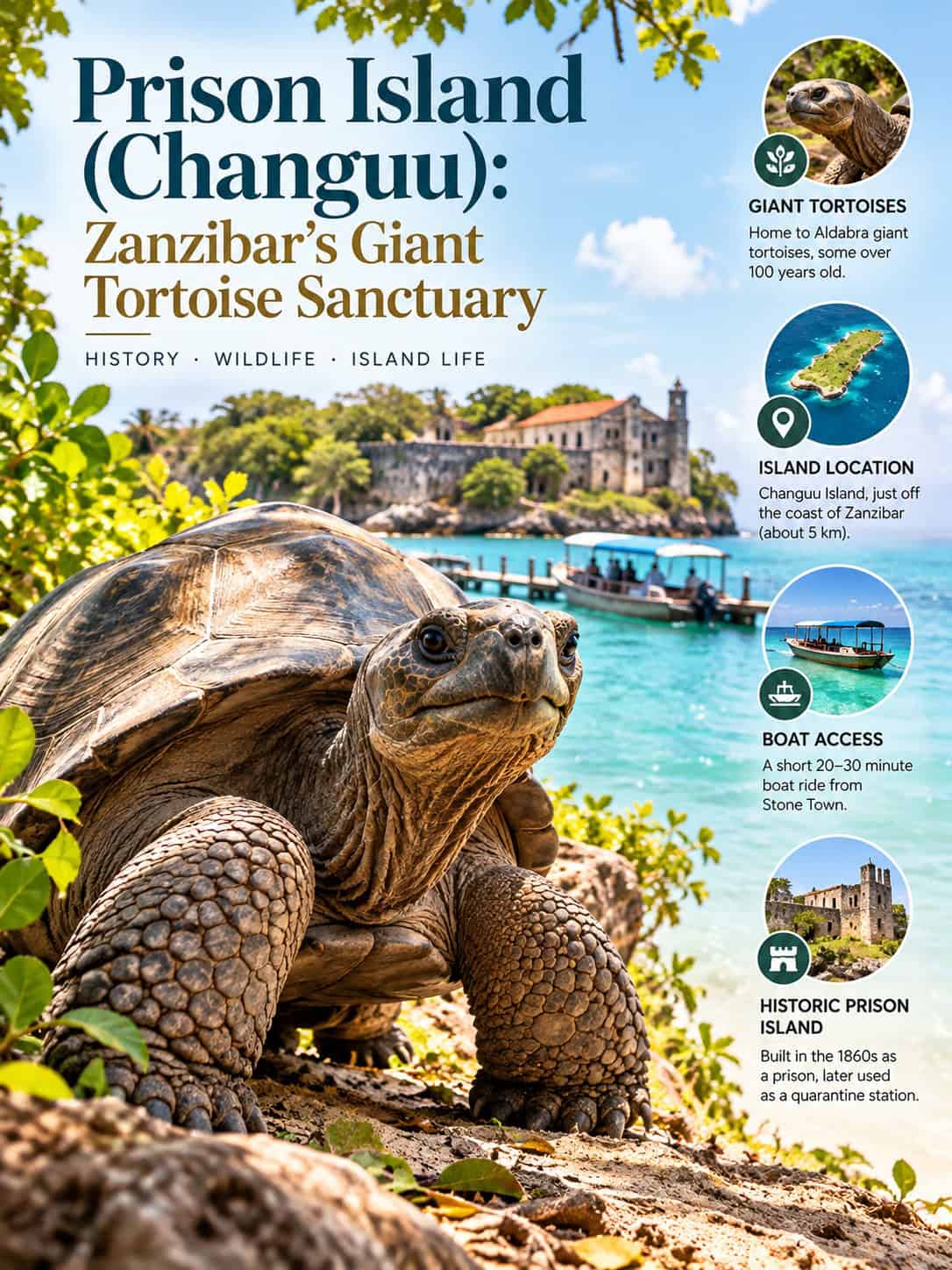
Prison Island Zanzibar, also called Changuu, is a small island a short boat ride from Stone Town. Visitors come for the Aldabra giant tortoise sanctuary, old colonial buildings and nearby snorkeling. Plan around the conservation fee and the tide.
The name is the first thing to get wrong about this place: Prison Island was built as a prison in 1893–94 but is generally reported never to have held prisoners. It later served as a quarantine station, then a leisure retreat, and today it is best known for its tortoise colony. The island is a half-day trip from Stone Town. Looking for a place to sleep nearby? Where to stay in Stone Town breaks down the options.
Prison Island Zanzibar: History of the Island
In 1893 Lloyd Mathews, First Minister of the Zanzibar protectorate, bought the small coral island known by its Swahili name Changuu and had a prison built there for offenders from the mainland. Construction finished by about 1894. The plan stalled and the buildings stayed empty, so “Prison Island” is a nickname for a prison that was not used as one.
Tour listings often say the island held enslaved people before the slave trade was abolished. Accounts differ on this: some sources say traders used the island in the 1860s, while other historical accounts place slave-era detention in the Stone Town seafront fort. Treat the claim as debated rather than settled.
The empty buildings later became a quarantine station for arrivals, mainly for yellow fever observation, during a period of heavy ship traffic and plague fears. The function faded in the twentieth century. The island became a quiet retreat for Europeans living in Zanzibar, old coral-mining pits turned into swimming pools, and a bungalow built for visiting dignitaries now serves as a small restaurant.
Prison Island Zanzibar: The Giant Tortoises
The island’s Aldabra giant tortoises come from a single atoll in the Seychelles, more than 2,500 km away. Several sources say the Governor of the Seychelles sent four of them to Zanzibar in 1919, and they became the founding population of the colony. One source places the gift earlier, so treat the exact date with some caution.
Published histories describe a population of roughly 200 by 1955 that collapsed under poaching for the pet and meat trade. A recovery effort in the 1990s, backed by an animal welfare group, built a protected compound and introduced hatchlings; by 2000 the island held about 17 adults, 50 juveniles and 90 hatchlings. Breeding continues and the colony is commonly described as around a hundred animals today, although no precise current census is published. Aldabra giant tortoises are listed as Vulnerable on the IUCN Red List. Their wild stronghold is still Aldabra Atoll itself, home to an estimated 180,000 tortoises.
Guides sometimes say the oldest tortoise is nearly 200 years old. In captivity the species can live for more than 150 years. Treat that as a guide’s estimate: ages of this kind are rarely documented, but the oldest animals are certainly very old.
Visiting the Tortoises: Feeding and Rules
A handler normally supervises feeding at the enclosure and explains the colony’s history. Greens are usually sold or provided at the entrance. Keep your fingers away from the tortoises’ necks, which move faster than their bodies suggest. Do not lift children onto a shell for photographs; staff discourage it and it can hurt the animal. The old prison and quarantine buildings are generally open to wander through at your own pace.
Prison Island Zanzibar: Entrance Fee and Conservation Charges
Zanzibar revised standard marine conservation charges from 1 September 2025 for areas including Changuu and Bawe. Non-East African adults pay US$10 and children aged 5–15 pay US$5. Non-East African Tanzanian residents pay US$5 for adults and US$3 for children. East African citizens pay TZS 5,000 for adults and TZS 2,500 for children. Children under five do not pay these fees.
Most visitors never pay that fee alone, because it is bundled into a tour that adds the boat, a guide and sometimes lunch or snorkel gear. One operator lists an extra island ticket of US$12 on top of the US$10 conservation fee, for US$22 collected in cash. That is one supplier’s breakdown, not a proven universal charge. Ask each operator which fees the quoted price includes.
Prison Island Entrance Fee by Visitor Type
| Visitor | Adult | Child |
|---|---|---|
| Non-East African visitor | US$10 | US$5 (aged 5–15) |
| Non-East African Tanzanian resident | US$5 | US$3 |
| East African citizen | TZS 5,000 | TZS 2,500 |
| Under five | Free | Free |
Ask whether the tour price includes it; some listings add a separate island admission, paid in cash on arrival.
Prison Island Zanzibar: How to Get There from Stone Town
Boats leave from the Stone Town waterfront near Forodhani Gardens and the crossing takes roughly 20–30 minutes each way, longer and choppier when the wind is up. There is no scheduled public ferry. Independent travellers can negotiate a fare with boat owners on the beach, which can be cheaper but means haggling and no guide on the island. A pre-booked tour costs more and usually includes a guide at the tortoise enclosure. A combined Prison Island and Nakupenda dhow trip with lunch on the sandbank is a full-day outing: one operator’s standard version runs seven to eight hours. No official opening hours are published for the island, so confirm timings with your operator or hotel.
Prison Island Tour or Independent Boat?
| Option | What you get | Check before paying |
|---|---|---|
| Pre-booked tour | Boat, guide, often fees and sometimes lunch | Which fees and extras are included |
| Independent boat | Return crossing agreed on the beach | Return time, fee paid on arrival, life jackets |
| Combined with Nakupenda | Tortoises plus a tidal sandbank | Tide times, total cost and length of day |
Prison Island Zanzibar: Snorkeling and the Rest of the Island
The sandy landing side is generally calm and reasonably clear for swimming, but boat traffic can make it busy in the mid-morning. The opposite side has a harder coral floor and is more tide-dependent. A small restaurant in the former European bungalow and a bar in part of the old prison building may serve food and drinks, but neither reliably operates outside peak season, so bring water and snacks. For more reef, see Nakupenda Sandbank, which many tours combine with Prison Island.
Prison Island Zanzibar: Who Should Visit?
Prison Island suits travellers on a Stone Town day who want one self-contained outing, families who will enjoy the tortoises (see the Zanzibar with kids itinerary) and anyone curious about colonial-era history. It is a half-day add-on, not a destination that needs its own overnight stay. Fit it into a two-day Stone Town plan or pair it with a spice tour for a full day.
Best Time to Visit Prison Island
June to October is generally drier, and January and February often bring another relatively dry spell. March to May usually has heavier rain and rougher water, which can delay or cancel boat trips. Conditions can change in any month; ask your operator about cancellation terms.
Prison Island Zanzibar: Practical Tips
- Fees: The conservation fee changed on 1 September 2025. Ask whether your tour includes it and any separate island ticket.
- Tortoise age: Treat very old claims as guide estimates.
- No riding tortoises: Never lift children onto a tortoise’s shell for a photo.
- Bring cash, water and snacks: Facilities are limited outside peak season, and fees and independent boat fares are usually cash. Carry small US dollar notes or Tanzanian shillings.
FAQ
Was Prison Island ever used as a prison?
It was built as one in 1893–94 but is generally reported never to have held prisoners. The buildings were later used for quarantine.
How much does it cost to visit Prison Island?
The marine conservation fee is US$10 for non-East African adults and US$5 for children aged 5–15, with lower rates for residents and East African citizens, effective 1 September 2025. Tours bundle it with the boat and guide, so confirm what your price includes.
Where did the giant tortoises come from?
Several sources say four Aldabra giant tortoises came as a gift from the Governor of the Seychelles in 1919. Poaching cut the colony drastically before a conservation programme rebuilt it.
How do I get to Prison Island?
By boat from the Stone Town waterfront near Forodhani Gardens, roughly 20–30 minutes each way. There is no scheduled ferry: negotiate a boat on the beach or book a tour that includes the transfer.
Is Prison Island worth visiting if I only have one day in Stone Town?
It works well as a half-day add-on to a Stone Town day for travellers who want the tortoises and some colonial history without committing a full extra day.
Boat trips to Prison Island and other Stone Town excursions can be compared and booked in advance.
 By Zanzibar With Me EditorialPublished Updated